
More News & Announcements →
Vol. 2 No. 2 (2023)
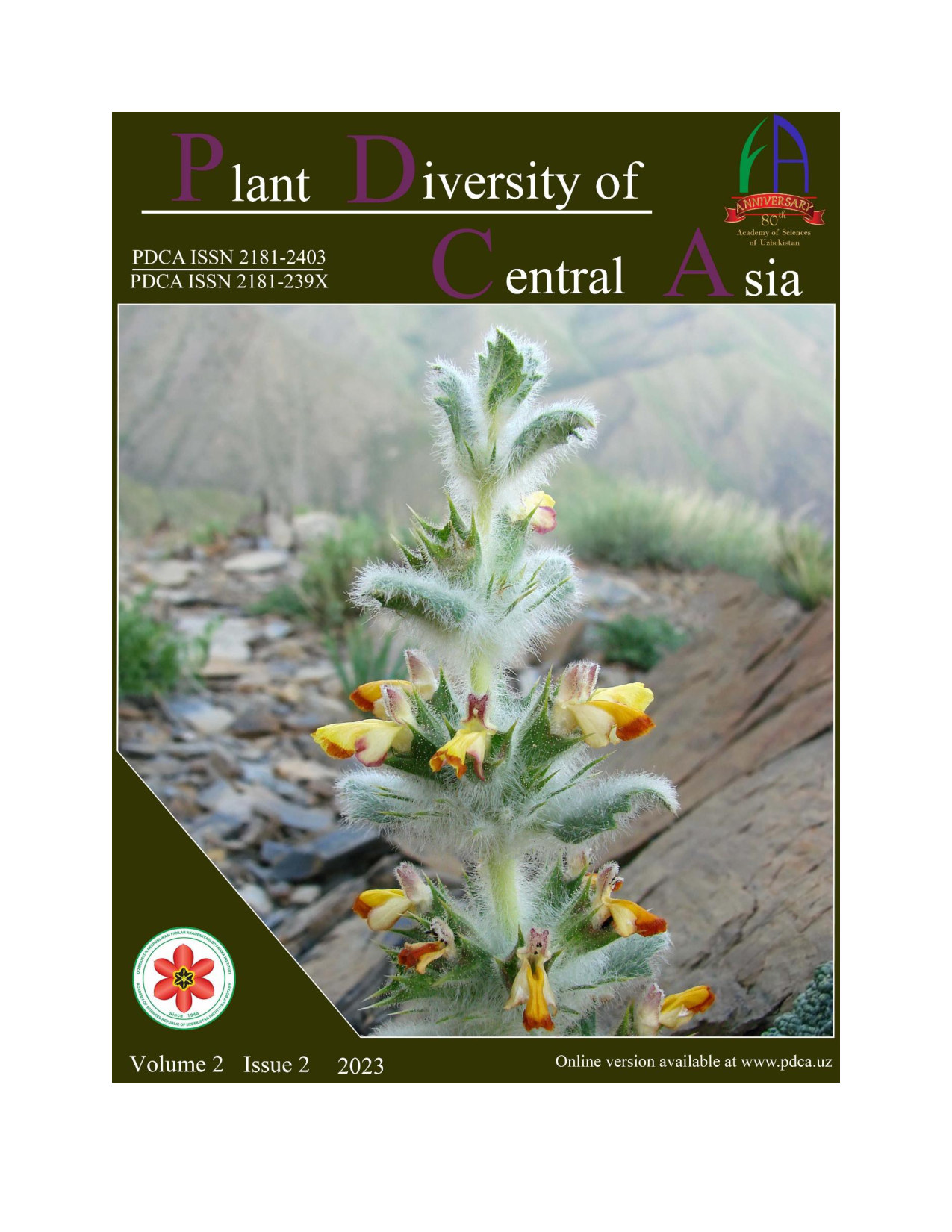
This issue of Plant Diversity of Central Asia (Vol. 2, No. 2, 2023) brings together pivotal contributions on the documentation, phylogenetic resolution, and multi-tiered conservation of Central Asia's unique and threatened flora, with a primary geographic focus on Uzbekistan. Integrating high-resolution molecular marker discovery, climate-informed species distribution modeling (SDM), and comprehensive threat assessments, the collected studies establish actionable paradigms for biodiversity management in a major global hotspot. Highlights include an interconnected regional conservation strategy linking in situ, ex situ, and quasi in situ approaches to recover severely threatened local endemics; an assessment of anthropogenic pressures on Uzbekistan’s Tulipa (Liliaceae) species along with new community-driven conservation models; predictive modeling of narrow endemics in the Nuratau Mountains detailing climate-driven habitat loss and the necessity of assisted migration; and complete plastid genome analyses of four Iris (subg. Scorpiris) species that pinpoint six high-divergence loci for resolving complex phylogenies. Together, these papers bridge molecular phylogenetics and spatial ecology to address the urgent conservation priorities of Central Asian botanical diversity.
Published:
2023-08-01
Articles
-
Research Article Open Access
Conservation strategy and diversity of Tulipa (Liliaceae) in Uzbekistan
License: cc BY 4.0Keywords: conservation; protected area; spatial distribution; Tulipa; in situ; ex situ; civic awarenessAbstract In light of the ongoing biodiversity crisis, appropriate conservation strategies are urgently needed. The steadily increasing anthropogenic pressure on nature in Central Asian countries seriously threatens the fate of local species and their habitats. Here, we analyze the threats to the genus… -
Research Article Open Access
How to preserve narrow endemics in view of climate change? The Nuratau Mountains as the case
License: cc BY 4.0Keywords: narrow endemics; climate change; species distribution modeling; Nuratau; protected areas; Central AsiaAbstract Endemic species usually have higher risk of extinction than widespread species and therefore for endemics negative effects of climate change can be especially dramatic. The Nuratau Mountains, located in Uzbekistan, are rich in endemic species and are a part of the Mountains of Central Asia Global… -
Research Article Open Access
Plastid genomes of four species of Iris from subgenus Scorpiris
License: cc BY 4.0Keywords: chloroplast genome; nucleotide divergence; phylogenic markers; phylogeny; IrisAbstract The taxonomic complexity of Iris (Iridaceae) is high, and its molecular phylogeny remains largely unknown. With the growing availability of full plastid genomes of species representing major taxonomic groups within Iris, it will become possible to produce a robust phylogenetic tree and reconstruct…
Review Articles
-
Research Article Open Access
Conservation of Central Asian plant biodiversity
License: cc BY 4.0Keywords: endangered plants; in situ; ex situ; quasi in situ; conservation guidelines; nature reserves; protected areasAbstract The severely threatened Central Asian (CA) flora requires a detailed conservation strategy well adapted to this region. The present review provides a detailed conservation methodology useful for every CA country that embraces ex situ and in situ approaches as inter-linked components. The proposed…
Short Communications
-
Research Article Open Access
New identity and neotypification of the mysterious Anethum involucratum (Umbelliferae) from the western Pamir-Alay (Uzbekistan)
License: cc BY 4.0Keywords: Anethum; Apiaceae; Galagania; Central Asia; Pamir-Alay; typification; Umbelliferae; UzbekistanAbstract Anethum involucratum is the last species of the Umbelliferae in the flora of Uzbekistan which remains taxonomically obscure due to the loss of its type material in Tashkent (TASH) where it should have been stored according to the protologue. A comparative study of descriptions of A. involucratum…