
More News & Announcements →
Vol. 1 No. 1 (2022)
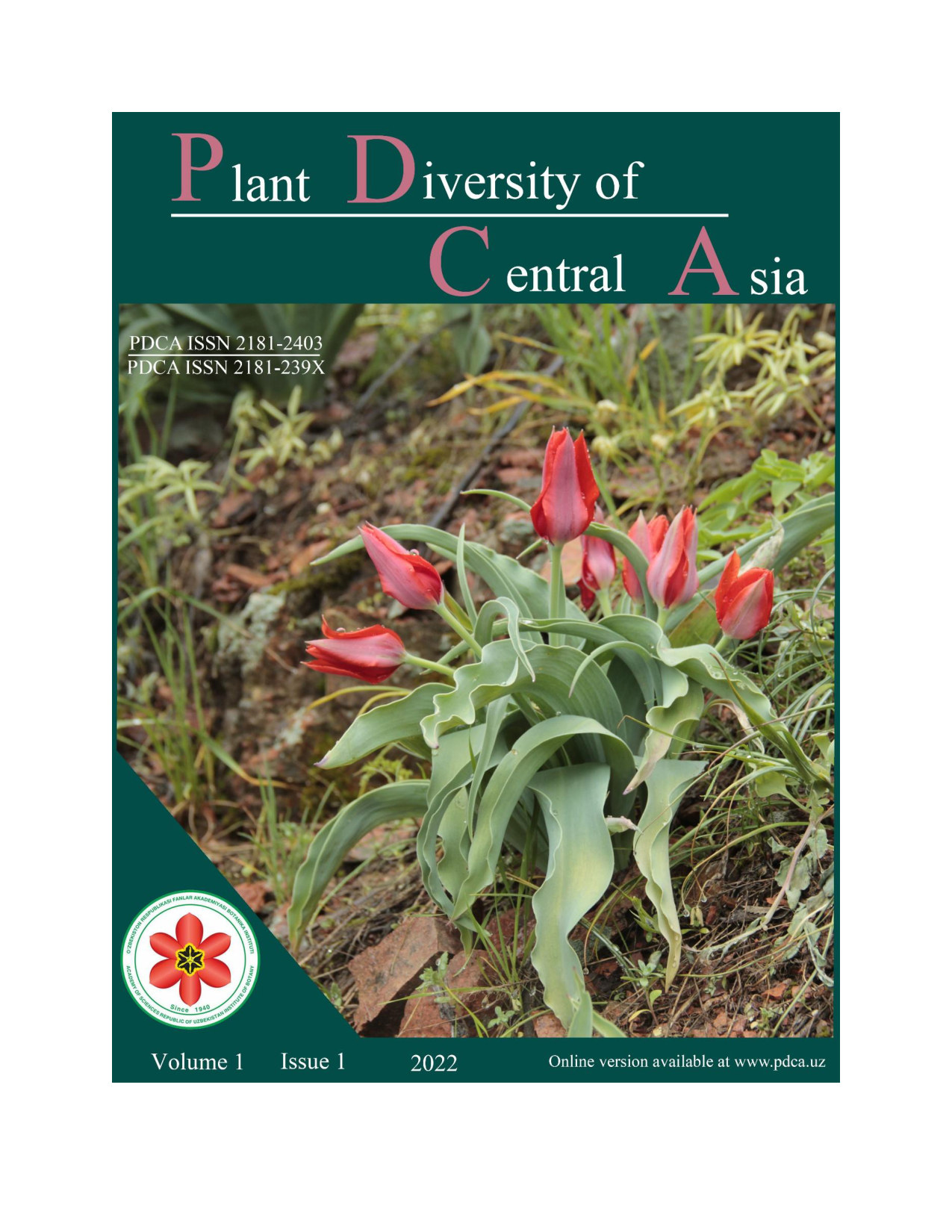
This issue of Plant Diversity of Central Asia (Vol. 1, No. 1, 2022) introduces foundational research spanning evolutionary genetics, phytogeography, comparative morphology, historical taxonomy, and conservation methodology across Central Asia. Across five articles, the inaugural issue examines local adaptation mechanisms in wild barley (Hordeum spontaneum), revealing that epistatic genetic interactions and local selection drive adaptation across aridity gradients; documents plant endemism in Uzbekistan's Surkhondaryo province, mapping 63 provincial endemics to highlight the Boysun region as a primary hotspot while noting the probable extinction of Dipcadi turkestanicum; presents a 24-character cladistic morphological analysis of 48 Tulipa species from their primary center of diversity in the Tian Shan and Pamir-Alay mountains; compiles a complete inventory of 130 Umbelliferae type specimens preserved in the National Herbarium of Uzbekistan (TASH), designating four new lectotypes; and outlines a conservation-oriented restoration paradigm designed to mitigate habitat degradation and safeguard threatened flora throughout Central Asia.
Published:
2022-04-01
Articles
-
Research Article Open Access
Endemic plant species richness of Surkhondaryo province, Uzbekistan
License: cc BY 4.0Keywords: Central Asia; endemism; phytogeography; national Red BookAbstract Surkhondaryo province is one of the largest and richest in vascular plant species diversity administrative units of Uzbekistan, which also has an extremely high concentration of species endemic to Mountainous Central Asia and Uzbekistan in particular. A characteristic geological feature of this… -
Research Article Open Access
Crossbreeding reveals the scale and genetic architecture of local adaptation in a predominantly selfing Hordeum spontaneum
License: cc BY 4.0Keywords: population differentiation; local adaptation; outbreeding depression; genetic architecture; experimental hybridization; wild barleyAbstract Environmental variation can be large across a wide range of spatial scales resulting in complex patterns of local adaptation across species ranges. We analyzed the scale, genetic mechanism and direct climatic causes of local adaptation in a widely distributed grass Hordeum spontaneum. We performed… -
Research Article Open Access
Conservation-oriented restoration and its application to Central Asia
License: cc BY 4.0Keywords: biodiversity; conservation strategy; restoration; threatened speciesAbstract Continuing wide-scale habitat degradation and species extinctions indicate that existing plant conservation practices are inadequate and new approaches are needed. I briefly summarize the major principles of a previously proposed concept called conservation- oriented restoration and compare it… -
Research Article Open Access
Taxonomic and nomenclatural inventory of the Umbelliferae in Central Asia, described on the basis of collections of the National Herbarium of Uzbekistan
License: cc BY 4.0Keywords: Central Asia; Herbarium TASH; Uzbekistan; nomenclature; typification; UmbelliferaeAbstract The National Herbarium of Uzbekistan (TASH) in Tashkent is the oldest and largest botanical collection not only in Uzbekistan, but also in the entire region of Central Asia. The article presents a complete inventory of the type material of Umbelliferae taxa stored in the National Herbarium of… -
Research Article Open Access
Morphology of tulips (Tulipa, Liliaceae) in its primary centre of diversity
License: cc BY 4.0Keywords: Tulipa; comparative morphology; morphology based phylogeny; cladistic analysisAbstract The Tian Shan and Pamir-Alay mountains of Central Asia are generally regarded as the primary center of diversity of Tulipa species, but a comparative morphological description of Central Asian Tulipa species is still lacking. To fill the existing gap, we studied 48 Tulipa species found in Central…