
More News & Announcements →
Vol. 1 No. 2 (2022)
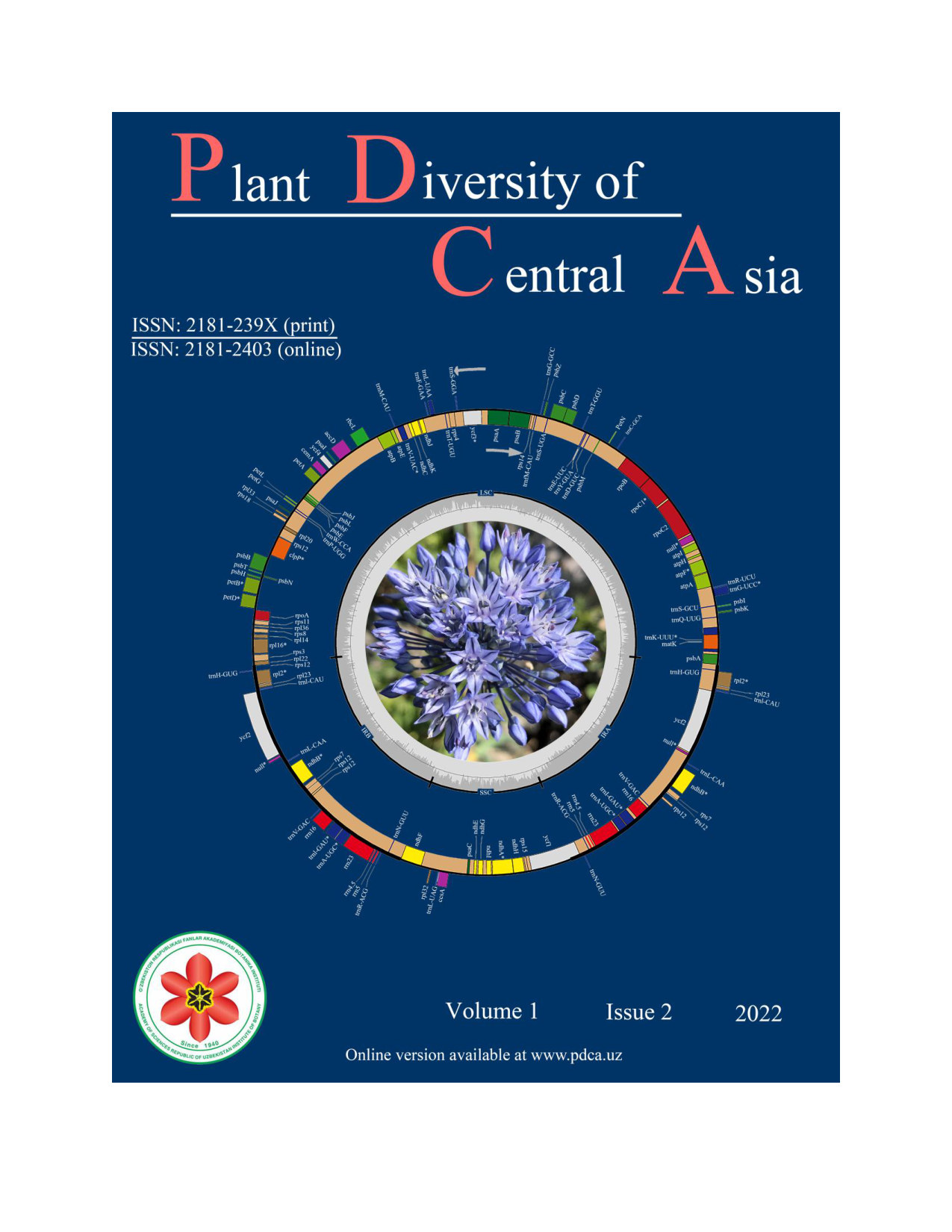
This issue of Plant Diversity of Central Asia (Vol. 1, No. 2, 2022) presents a comprehensive synthesis of spatial conservation tools, historical taxonomy, geospatial modeling, morphological cladistics, and phylogenomics focusing on Central Asian plant diversity. Across five contributions, the issue highlights the utility of Species Distribution Modeling (SDM) for reserve design, translocation, and estimating critical habitats for narrow endemics; commemorates the legacy and taxonomic achievements of Aleksei Ivanovich Vvedensky (1898–1972), founder of the National Herbarium of Uzbekistan (TASH); examines environmental drivers of Tulipa distributions in Uzbekistan via SDM, revealing altitude (700–2200 m) and climate as primary determinants alongside topography for select species; provides a cladistic analysis, updated identification key, and taxonomic synopsis for 32 Eremurus species (Asphodelaceae) in Uzbekistan; and sequences full chloroplast genomes for 10 Central Asian Allium species (subg. Allium), identifying key variable genes while demonstrating discordance between plastid phylogenetics and traditional sectional classifications.
Published:
2022-08-01
Articles
-
Research Article Open Access
Genus Eremurus (Asphodelaceae) in the flora of Uzbekistan
License: cc BY 4.0Keywords: cladistic analysis; Central Asia; synopsis; taxonomy; morphology; Ammolirion; HenningiaAbstract In this study, 13 morphological characters in 32 species of Eremurus (Asphodelaceae) from Uzbekistan were examined and subjected to cladistic analysis. In the consensus tree, species from subgenus Eremurus clustered together, but did not form a distinct clade sister to Henningia. The subrotate… -
Research Article Open Access
What determines the distribution of Tulipa species in Uzbekistan?
License: cc BY 4.0Keywords: geospatial analysis; species richness; species range; species distribution modelingAbstract Although the distribution of Tulipa species in Uzbekistan is well documented, there is no clear understanding of the importance of three classes of environmental variables, climate, soil type, and topography, as determinants of their distribution. We mapped the richness of Tulipa species in… -
Research Article Open Access
Complete chloroplast genomes of ten species from subgenus Allium (Allium, Amaryllidaceae)
License: cc BY 4.0Keywords: phylogeny; plastome; nucleotide polymorphism; pseudogeneAbstract Subgenus Allium is the largest group within the genus Allium (Amaryllidaceae) which detailed phylogenetic classification is still missing despite intensive phylogenetic research. Reconstruction of the subgenus phylogeny is impossible without proper coverage of the subgenus members representing…
Review Articles
-
Research Article Open Access
Prominent botanists of Central Asia: Vvedensky Aleksei Ivanovich (1898-1972)
License: cc BY 4.0Keywords: Allium; Iris; Eremurus; bibliography; Vvedensky; taxonomy; Middle AsiaAbstract This article honours the memory of the outstanding taxonomist and tireless researcher of the flora of Central Asia, Aleksei Ivanovich Vvedensky, the founder of the most extensive Central Asian herbarium collection, the author of monographic revisions in ‘Flora of the USSR’, the editor and author… -
Research Article Open Access
Species Distribution Modeling - a conservation tool with a wide spectrum of applications in Central Asia
License: cc BY 4.0Keywords: conservation planning; reserve design; reintroduction; restoration; threatened speciesAbstract The goal of this paper was to review and illustrate the utility of SDM for solving conservation problems. Using real-world examples, I show a variety of uses for SDM, and then review the existing and potential applications of SDM for plant conservation in Central Asia. Central Asia is the region…